Download Ebook Engineering Materials Technology: Structures, Processing, Properties and Selection (4th Edition), by James A. Jacobs, Thomas F. Kilduff, J
The factor of why you could receive as well as get this Engineering Materials Technology: Structures, Processing, Properties And Selection (4th Edition), By James A. Jacobs, Thomas F. Kilduff, J sooner is that this is guide in soft data kind. You can check out guides Engineering Materials Technology: Structures, Processing, Properties And Selection (4th Edition), By James A. Jacobs, Thomas F. Kilduff, J wherever you desire even you remain in the bus, office, house, and other areas. However, you could not should relocate or bring guide Engineering Materials Technology: Structures, Processing, Properties And Selection (4th Edition), By James A. Jacobs, Thomas F. Kilduff, J print anywhere you go. So, you will not have heavier bag to bring. This is why your option to make better idea of reading Engineering Materials Technology: Structures, Processing, Properties And Selection (4th Edition), By James A. Jacobs, Thomas F. Kilduff, J is actually valuable from this instance.
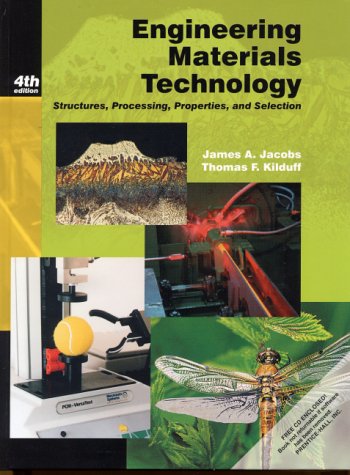
Engineering Materials Technology: Structures, Processing, Properties and Selection (4th Edition), by James A. Jacobs, Thomas F. Kilduff, J

Download Ebook Engineering Materials Technology: Structures, Processing, Properties and Selection (4th Edition), by James A. Jacobs, Thomas F. Kilduff, J
Engineering Materials Technology: Structures, Processing, Properties And Selection (4th Edition), By James A. Jacobs, Thomas F. Kilduff, J. Happy reading! This is exactly what we desire to say to you that enjoy reading a lot. Exactly what concerning you that declare that reading are only obligation? Don't bother, reading practice should be begun with some particular factors. Among them is reviewing by obligation. As exactly what we intend to supply below, the publication qualified Engineering Materials Technology: Structures, Processing, Properties And Selection (4th Edition), By James A. Jacobs, Thomas F. Kilduff, J is not type of obligated e-book. You can enjoy this publication Engineering Materials Technology: Structures, Processing, Properties And Selection (4th Edition), By James A. Jacobs, Thomas F. Kilduff, J to review.
Keep your means to be below and read this resource completed. You could take pleasure in looking guide Engineering Materials Technology: Structures, Processing, Properties And Selection (4th Edition), By James A. Jacobs, Thomas F. Kilduff, J that you really describe get. Below, getting the soft file of guide Engineering Materials Technology: Structures, Processing, Properties And Selection (4th Edition), By James A. Jacobs, Thomas F. Kilduff, J can be done effortlessly by downloading and install in the web link web page that we provide here. Naturally, the Engineering Materials Technology: Structures, Processing, Properties And Selection (4th Edition), By James A. Jacobs, Thomas F. Kilduff, J will be all yours earlier. It's no have to get ready for guide Engineering Materials Technology: Structures, Processing, Properties And Selection (4th Edition), By James A. Jacobs, Thomas F. Kilduff, J to obtain some days later after acquiring. It's no need to go outside under the heats at center day to go to guide shop.
This is a few of the benefits to take when being the participant and obtain guide Engineering Materials Technology: Structures, Processing, Properties And Selection (4th Edition), By James A. Jacobs, Thomas F. Kilduff, J right here. Still ask what's different of the various other website? We offer the hundreds titles that are produced by advised writers and authors, worldwide. The link to buy and also download and install Engineering Materials Technology: Structures, Processing, Properties And Selection (4th Edition), By James A. Jacobs, Thomas F. Kilduff, J is likewise quite simple. You could not discover the complex website that order to do even more. So, the way for you to obtain this Engineering Materials Technology: Structures, Processing, Properties And Selection (4th Edition), By James A. Jacobs, Thomas F. Kilduff, J will be so simple, will not you?
Based upon the Engineering Materials Technology: Structures, Processing, Properties And Selection (4th Edition), By James A. Jacobs, Thomas F. Kilduff, J specifics that we offer, you may not be so confused to be here as well as to be participant. Obtain currently the soft file of this book Engineering Materials Technology: Structures, Processing, Properties And Selection (4th Edition), By James A. Jacobs, Thomas F. Kilduff, J and save it to be all yours. You conserving can lead you to evoke the convenience of you in reading this book Engineering Materials Technology: Structures, Processing, Properties And Selection (4th Edition), By James A. Jacobs, Thomas F. Kilduff, J Even this is kinds of soft file. You could really make better opportunity to obtain this Engineering Materials Technology: Structures, Processing, Properties And Selection (4th Edition), By James A. Jacobs, Thomas F. Kilduff, J as the recommended book to read.
This exceptionally readable reference offers current and cutting edge information on “materials.” —Knowledge that can simplify and make living more enjoyable for people who maintain households, and purchase such life necessities as automobiles and houses. It helps create informed and intelligent consumers who know how to care for and maintain the things they purchase, and maintain the only place we have to live, namely this earth—which is running out of its natural raw materials and is being polluted with the products of our technological world. Chapter topics include engineering materials technology; nature and family of materials; processing and structure of solid materials; and properties, degradation, failure, and selection of materials. These subjects cover metallic, polymeric, ceramic, and composite materials. For anyone who works and/or lives with materials.
- Sales Rank: #1365910 in Books
- Published on: 2000-08-08
- Original language: English
- Number of items: 1
- Dimensions: 11.25" h x 1.38" w x 8.50" l,
- Binding: Hardcover
- 767 pages
From the Inside Flap
Preface
Advances in materials science and engineering have had a profound effect on the world's technological development. The present-day globalization of the world's economy is driven by high technology, and the research and development of materials is in the forefront of our changing world society. As a consequence many people can benefit from a study of engineering materials technology. Our first edition was written for students in engineering and industrial technology programs. Since then we have learned that many other people found our text refreshing and useful to them, including professors, secondary school teachers, and industrial trainers with the responsibility to teach materials science and technology subjects.
Because materials technology is so pervasive in our readers' lives, we continually encourage them to become "materials observers" and point out the relevance of this important subject as seen in everyday products and systems. Another effective teaching tool for learning, in evidence since the original text, is the use of integrated common themes: 1) relationships among structure, properties, processing, and applications of materials, 2) the importance of consideration of the total Materials Cycle in material synthesis, selection, processing, and economics, 3) the need for environmentally friendly design and manufacturing of systems and products, 4) new and/or improved technologies that influence many aspects of engineering materials technology such as micro/nanotechnology, recycling, surface engineering, smart materials, intelligent structures, and biomimetrics, 5) encouragement for the reader to explore the many resources and databases outside this book including the use of the Internet, and 6) the role of standard practices in all aspects of design, testing, processing, manufacturing, selection, and applications of materials.
In a rapidly advancing society, people must have a sufficient technical background to understand the basis for those new technologies thrust upon them on nearly a daily basis. But this understanding is only a first step. To make a living using these new technologies will be a necessity. All of us will be called upon to be better users of these technological developments which will require the use of less of the earth's dwindling resources accompanied by a reduction in pollution of the planet earth. Accomplishing these broad objectives calls for not only intelligent citizens but intelligent consumers. Throughout the book we point to efforts to strike a balance between improving materials, processes, products, and systems and those impacts on our environment with approaches such as "green design," "green manufacturing" and "green materials:" Building on the drive for "green design and manufacturing" for a sustainable environment we have included extensive coverage of product and system Life Cycle Analysis as related to the total Materials Cycle.
We have added a number of new features to this edition of the text, such as the EMT WEBLINKS in each module. These links will help students view dramatic images, animations and movies, probe databases, and observe R&D at corporations, universities, and government laboratories. They also permit the learners to explore numerous examples of the rapid advancements in the fields of material sciences and engineering, and in some cases engage in tutorials and other interactive exercises. Also, a color section provides vivid images of a wide array of example materials, which are among the many new graphics that help illustrate concepts.
Knowledge of new, advanced materials in all members of the family of materials is extensive. In addition, problems incurred in actually applying these materials are also brought to the attention of our readers. The span of time and the development efforts expanded on bringing new advance materials to the production phase are described. The development of technologies that will permit these materials to be processed economically in industry and the ever-present need for compromise in applying these new materials to safe and reliable products and structures is examined. The above statements are sufficient justification for more study of the role of processing and fabrication of today's engineering materials. Near-net shaping, rapid solidification, rapid prototyping, thermal spraying, hydroforming, and tailored blanks are but few of such subjects. We also examine materials as found in building construction and civil engineering technologies. Corrosion gets expanded coverage, including electrochemistry principles, methods of corrosion prevention, and better design procedures, due to the recognized fact that all materials are subjected to corrosion under service conditions.
To present the fundamentals of materials science on a level appropriate to learners who have not completed formal courses in chemistry, physics or mathematics beyond the uses of algebra is uppermost in our mind. As a consequence the terminology is defined while using a maximum of graphics such as equations, graphs, tables, and micrographs. Illustrative problems requiring calculations are numerous whenever a law or principle can be expressed as an equation. Emphasis is consistently placed on the proper use of units in solving equations using both the English and International System (SI) of units. Substitution of units as well as numbers in equations is stressed as being essential for arriving at a correct answer. Problems in materials science, in general, require a degree of creative analysis of concepts coupled with research into databases in order to solve them. Ample opportunity for this type of problem-solving endeavor is provided by problems contained in each module's Self Assessment section. Many of these types of questions can serve as useful class discussions. ORGANIZATION
The book is organized in self-contained modules that consist of:
Module Outcomes that present what the reader should be able to do after studying the module; Pause & Ponders that present case studies or applications of materials developments, aimed at sparking the reader's interest and providing a reason to learn the content; Solved problems and numerous illustrations and examples representing a full range of products, systems, and technologies that support concepts within the module's topic; Applications & Alternatives that reinforce the concepts learned by illustrating current use of the information; Self-Assessments that provide open-ended essay questions, problems to solve, and objective questions; References & Related Readings that provide source information, plus a listing of useful handbooks, journals, periodicals, and similar data; and Listings of Experiments and Updates from past National Educators Workshops, which can be obtained by using information in the Instructor's Manual.
The experiments and demonstrations listed in each module have been tested and thoroughly peer-reviewed and offer some excellent activities to supplement the text. The answers to all the problems and questions for the Self-Assessments are available in the Instructor's Manual, which offers a test bank from the Self-Assessments and other useful supplements.
The book's organization—including numerous tables in modules, and extensive appendices, coupled with key terms highlighted in bold face—make it comprehensive enough to serve as a Ready Reference Book on materials for the immediate future and beyond.
Please become familiar with the Contents and Index section. We have taken great care to fully develop these features in order to help you make the many cross-references required of this wide-ranging discipline of engineering materials technology. With the Contents you can locate many useful aids in the Appendix such as Greek symbols, S1/US Customary conventions and conversions, tables of properties, ASTM abbreviations, hardness to strength conversions, trade names, material selection guides, and more. Within modules you will find useful visual aids such as our hardness scale comparison figure. All of these features are cross-referenced in the Index. This book should be a useful guide or ready reference, much like Machinery's Handbook, which you should keep at your side as you engage in engineering/industrial problem solving. NEW: UPDATES AND OTHER RESOURCES
As creator of the National Educators Workshop series (NEW: Update) in 1986, Jim Jacobs has co-directed these annual workshops which aimed at providing emerging concepts on engineering materials, science, and technology with emphasis on laboratory experiments. Major sponsors of these workshops and related research were the National Aeronautics and Space Administration (NASA), National Institute of Standards and Technology (NIST), and Department of Energy (DOE). Faculty from community colleges, four-year colleges, and major universities from across the United States, Canada, and other nations gathered at these sessions to share ideas on more effective materials education. Many of the leading corporate and governmental agencies with materials science and engineering laboratories prov
From the Back Cover
Life Cycle Analysis of products and systems has become an industry imperative in recognition of the need for green design and manufacturing for a sustainable environment. This edition effectively weaves in Life Cycle Analysis as related to the total Materials Cycle now being adopted on a global scale.
The book's extensive index and handy tables qualify it as a useful "ready reference," on the job or elsewhere.
You will learn about engineering materials and many associated topics through an integrated approach centering around innovative trends in design and manufacturing that often focus on environmentally friendly processes and products. Special strategies and clear explanations clarify the relationships among the following major facets of materials technology:
STRUCTURES must be understood to grasp the values and limitations of materials. Materials engineering has developed many approaches to changing structures. An understanding of micro and macro structures leads to knowledge of the new "designed" structures of our advanced materials, which result from many new methods of synthesis and processing.
PROCESSING is studied in terms of how raw materials determine certain processes and how processing changes structure through both traditional and emerging new methods. Effective diagrams, photomicrographs, and photographs promote comprehension of many processes.
PROPERTIES are now controlled better as a result of the many new processes presented in this book. You will learn how designers specify a material's properties for designed materials rather than being limited to off-the-shelf materials. With these selections, designers can meet the demands of our advanced technological society.
SELECTION from the ever-increasing variety of materials requires efficient problem-solving skills as taught in this book. The tables, graphs, and numerous interesting and unusual applications will aid you in learning effective materials selection and consumption of the world's limited material resources.
Excerpt. � Reprinted by permission. All rights reserved.
Preface
Advances in materials science and engineering have had a profound effect on the world's technological development. The present-day globalization of the world's economy is driven by high technology, and the research and development of materials is in the forefront of our changing world society. As a consequence many people can benefit from a study of engineering materials technology. Our first edition was written for students in engineering and industrial technology programs. Since then we have learned that many other people found our text refreshing and useful to them, including professors, secondary school teachers, and industrial trainers with the responsibility to teach materials science and technology subjects.
Because materials technology is so pervasive in our readers' lives, we continually encourage them to become "materials observers" and point out the relevance of this important subject as seen in everyday products and systems. Another effective teaching tool for learning, in evidence since the original text, is the use of integrated common themes: 1) relationships among structure, properties, processing, and applications of materials, 2) the importance of consideration of the total Materials Cycle in material synthesis, selection, processing, and economics, 3) the need for environmentally friendly design and manufacturing of systems and products, 4) new and/or improved technologies that influence many aspects of engineering materials technology such as micro/nanotechnology, recycling, surface engineering, smart materials, intelligent structures, and biomimetrics, 5) encouragement for the reader to explore the many resources and databases outside this book including the use of the Internet, and 6) the role of standard practices in all aspects of design, testing, processing, manufacturing, selection, and applications of materials.
In a rapidly advancing society, people must have a sufficient technical background to understand the basis for those new technologies thrust upon them on nearly a daily basis. But this understanding is only a first step. To make a living using these new technologies will be a necessity. All of us will be called upon to be better users of these technological developments which will require the use of less of the earth's dwindling resources accompanied by a reduction in pollution of the planet earth. Accomplishing these broad objectives calls for not only intelligent citizens but intelligent consumers. Throughout the book we point to efforts to strike a balance between improving materials, processes, products, and systems and those impacts on our environment with approaches such as "green design," "green manufacturing" and "green materials:" Building on the drive for "green design and manufacturing" for a sustainable environment we have included extensive coverage of product and system Life Cycle Analysis as related to the total Materials Cycle.
We have added a number of new features to this edition of the text, such as the EMT WEBLINKS in each module. These links will help students view dramatic images, animations and movies, probe databases, and observe R&D at corporations, universities, and government laboratories. They also permit the learners to explore numerous examples of the rapid advancements in the fields of material sciences and engineering, and in some cases engage in tutorials and other interactive exercises. Also, a color section provides vivid images of a wide array of example materials, which are among the many new graphics that help illustrate concepts.
Knowledge of new, advanced materials in all members of the family of materials is extensive. In addition, problems incurred in actually applying these materials are also brought to the attention of our readers. The span of time and the development efforts expanded on bringing new advance materials to the production phase are described. The development of technologies that will permit these materials to be processed economically in industry and the ever-present need for compromise in applying these new materials to safe and reliable products and structures is examined. The above statements are sufficient justification for more study of the role of processing and fabrication of today's engineering materials. Near-net shaping, rapid solidification, rapid prototyping, thermal spraying, hydroforming, and tailored blanks are but few of such subjects. We also examine materials as found in building construction and civil engineering technologies. Corrosion gets expanded coverage, including electrochemistry principles, methods of corrosion prevention, and better design procedures, due to the recognized fact that all materials are subjected to corrosion under service conditions.
To present the fundamentals of materials science on a level appropriate to learners who have not completed formal courses in chemistry, physics or mathematics beyond the uses of algebra is uppermost in our mind. As a consequence the terminology is defined while using a maximum of graphics such as equations, graphs, tables, and micrographs. Illustrative problems requiring calculations are numerous whenever a law or principle can be expressed as an equation. Emphasis is consistently placed on the proper use of units in solving equations using both the English and International System (SI) of units. Substitution of units as well as numbers in equations is stressed as being essential for arriving at a correct answer. Problems in materials science, in general, require a degree of creative analysis of concepts coupled with research into databases in order to solve them. Ample opportunity for this type of problem-solving endeavor is provided by problems contained in each module's Self Assessment section. Many of these types of questions can serve as useful class discussions.
ORGANIZATIONThe book is organized in self-contained modules that consist of:
- Module Outcomes that present what the reader should be able to do after studying the module;
- Pause & Ponders that present case studies or applications of materials developments, aimed at sparking the reader's interest and providing a reason to learn the content;
- Solved problems and numerous illustrations and examples representing a full range of products, systems, and technologies that support concepts within the module's topic;
- Applications & Alternatives that reinforce the concepts learned by illustrating current use of the information;
- Self-Assessments that provide open-ended essay questions, problems to solve, and objective questions;
- References & Related Readings that provide source information, plus a listing of useful handbooks, journals, periodicals, and similar data; and
- Listings of Experiments and Updates from past National Educators Workshops, which can be obtained by using information in the Instructor's Manual.
The experiments and demonstrations listed in each module have been tested and thoroughly peer-reviewed and offer some excellent activities to supplement the text. The answers to all the problems and questions for the Self-Assessments are available in the Instructor's Manual, which offers a test bank from the Self-Assessments and other useful supplements.
The book's organization—including numerous tables in modules, and extensive appendices, coupled with key terms highlighted in bold face—make it comprehensive enough to serve as a Ready Reference Book on materials for the immediate future and beyond.
Please become familiar with the Contents and Index section. We have taken great care to fully develop these features in order to help you make the many cross-references required of this wide-ranging discipline of engineering materials technology. With the Contents you can locate many useful aids in the Appendix such as Greek symbols, S1/US Customary conventions and conversions, tables of properties, ASTM abbreviations, hardness to strength conversions, trade names, material selection guides, and more. Within modules you will find useful visual aids such as our hardness scale comparison figure. All of these features are cross-referenced in the Index. This book should be a useful guide or ready reference, much like Machinery's Handbook, which you should keep at your side as you engage in engineering/industrial problem solving.
NEW: UPDATES AND OTHER RESOURCESAs creator of the National Educators Workshop series (NEW: Update) in 1986, Jim Jacobs has co-directed these annual workshops which aimed at providing emerging concepts on engineering materials, science, and technology with emphasis on laboratory experiments. Major sponsors of these workshops and related research were the National Aeronautics and Space Administration (NASA), National Institute of Standards and Technology (NIST), and Department of Energy (DOE). Faculty from community colleges, four-year colleges, and major universities from across the United States, Canada, and other nations gathered at these sessions to share ideas on more effective materials education. Many of the leading corporate and governmental agencies with materials science and engineering laboratories provided updates at the workshops on the full range of materials developments. The seminars presented at these workshops provided us with an opportunity to learn of the latest improvements. Much of the fine work of all the contributors to NEW:Updates has been compiled into a useful CD-ROM, EMSET 2 (Experiments in Materials Science and Engineering 2) to complement the book as well as other courses. This CD-ROM, now in its second edition, has over 350 experiments and demonstrations as well as numerous color images, web links and other instructional aids that should serve as a valuable supplement to a variety of courses.
Since our last edition the Internet has exploded and technical CD-ROMs have become readily available. The Materials Science and Technology Gateway website, http://MST-online.nsu.edu, (housed at Norfolk State University with links to excellent sites) is one example of many Internet resources you will find useful in addition to the many URLs listed in the book.
The enclosed demonstration CD-ROM of MaterialTool by Wroblewski and Vanka, provides another useful supplement. This demo disk provides a sampling of the user-friendly, interactive software that catalogues over 1,000 materials and manufacturing processes—all fully supported with clear text descriptions, images, animations, property tables, hyperlinks, and references.
Most helpful customer reviews
0 of 0 people found the following review helpful.
The book itself looks like a bad black and white photocopy of another book
By Blake Billiot
Book was delivered very quickly so I cannot fault the seller for the issues. The book itself looks like a bad black and white photocopy of another book. Some of the words are smeared and most of the pictures are hard to see. It was also very hard to stay interested in the material because of the way its written and I love manufacturing. There are definitely better books out there.
1 of 1 people found the following review helpful.
Mandatory Title
By Mark M
Much cheaper than the 5th edition, and nearly word for word identical, though some chapters are swapped.
I was gonna rate it 3 stars, but it was one of the more interesting and easy to understand textbooks I've used this semester, so I bumped it up to 4.
0 of 0 people found the following review helpful.
I got this book for a class. Very informative ...
By Paul
I got this book for a class. Very informative but very heavy text as well (and a heavy book to lug around).
Engineering Materials Technology: Structures, Processing, Properties and Selection (4th Edition), by James A. Jacobs, Thomas F. Kilduff, J PDF
Engineering Materials Technology: Structures, Processing, Properties and Selection (4th Edition), by James A. Jacobs, Thomas F. Kilduff, J EPub
Engineering Materials Technology: Structures, Processing, Properties and Selection (4th Edition), by James A. Jacobs, Thomas F. Kilduff, J Doc
Engineering Materials Technology: Structures, Processing, Properties and Selection (4th Edition), by James A. Jacobs, Thomas F. Kilduff, J iBooks
Engineering Materials Technology: Structures, Processing, Properties and Selection (4th Edition), by James A. Jacobs, Thomas F. Kilduff, J rtf
Engineering Materials Technology: Structures, Processing, Properties and Selection (4th Edition), by James A. Jacobs, Thomas F. Kilduff, J Mobipocket
Engineering Materials Technology: Structures, Processing, Properties and Selection (4th Edition), by James A. Jacobs, Thomas F. Kilduff, J Kindle

Tidak ada komentar:
Posting Komentar